Many government AC procurement packages in Indonesia fail at the same point: the specification only says "2 PK AC, 10 units". Bidders then offer units with different capacities, efficiencies and installation scopes, and the procurement officer (PPK) cannot compare the bids fairly.
This article is for procurement officers in government agencies and for design consultants who prepare tender documents for split, cassette or VRV air conditioning. The short answer: a good specification states measurable performance parameters, a complete installation scope and testing requirements, without steering the tender to one brand.
An AC technical specification is the part of a procurement document that describes the AC units and materials an agency is buying. For split and cassette AC, it should cover at least 10 parameters, from capacity in BTU/h or kW to testing requirements. VRV/VRF systems need 7 additional system parameters, such as pipe length limits and central controls.
What is the difference between a technical specification and a KAK?
A technical specification describes the goods being bought, while a Kerangka Acuan Kerja (KAK, terms of reference) describes the service work. Both are governed by Presidential Regulation 16 of 2018 on Government Procurement, as amended by Presidential Regulations 12 of 2021 and 46 of 2025.
AC procurement almost always combines the two. Indoor units, outdoor units, piping and insulation are goods. Installation, testing, commissioning and maintenance are services. When AC is bought without a clear installation scope, extra costs usually appear during the work.
Which regulations apply to AC specifications?
AC specifications for government buildings refer to procurement rules, state building rules and technical air-conditioning standards. The table below lists the references used most often.
| Regulation or standard | What it covers for AC procurement |
|---|---|
| Presidential Regulation 16/2018, amended by 12/2021 and 46/2025 | How to write specifications and KAK, limits on naming brands, the obligation to prioritise domestic products with TKDN |
| Minister of Public Works Regulation 22/PRT/M/2018 on State Building Construction | Air conditioning must suit the building's function and consider energy conservation; BIM is mandatory for non-simple state buildings above 2,000 m² and above 2 floors |
| SNI 6390:2020 | Energy conservation for air-conditioning systems in buildings |
| SNI 03-6572-2001 | Design procedure for ventilation and air-conditioning systems in buildings |
| Minister of Public Works Regulation 8 of 2023 | Guidelines for construction cost estimates (replacing Regulation 1/2022), used when preparing the owner's estimate (HPS) |
Regulatory status can change. Before issuing a document, check the latest status on the Ministry of Public Works legal database (JDIH PU), JDIH BPK and the BSN standards database.
What must a split or cassette AC specification include?
A split or cassette AC specification should cover capacity, efficiency, electrical data, refrigerant, TKDN, warranty and installation scope. Use this list as a framework:
- Cooling capacity in BTU/h or kW per room, from a load calculation. Do not write PK alone.
- Unit type: wall split, cassette, ducted or floor standing, matched to the ceiling and the room's use.
- Compressor technology: inverter or fixed speed. For rooms used many hours a day, inverter units usually use less energy.
- Energy efficiency: the energy-saving label issued under the Ministry of Energy (ESDM) scheme, or the efficiency value from the manufacturer's data.
- Electrical data: voltage, phase and running current. Check the building's connected load before adding units.
- Refrigerant: an environmentally friendly refrigerant according to the manufacturer's data.
- TKDN: the local content value on the Ministry of Industry certificate, following the domestic product rules in Presidential Regulation 46/2025.
- Warranty: unit and compressor warranty per the manufacturer, plus an installation warranty from the contractor.
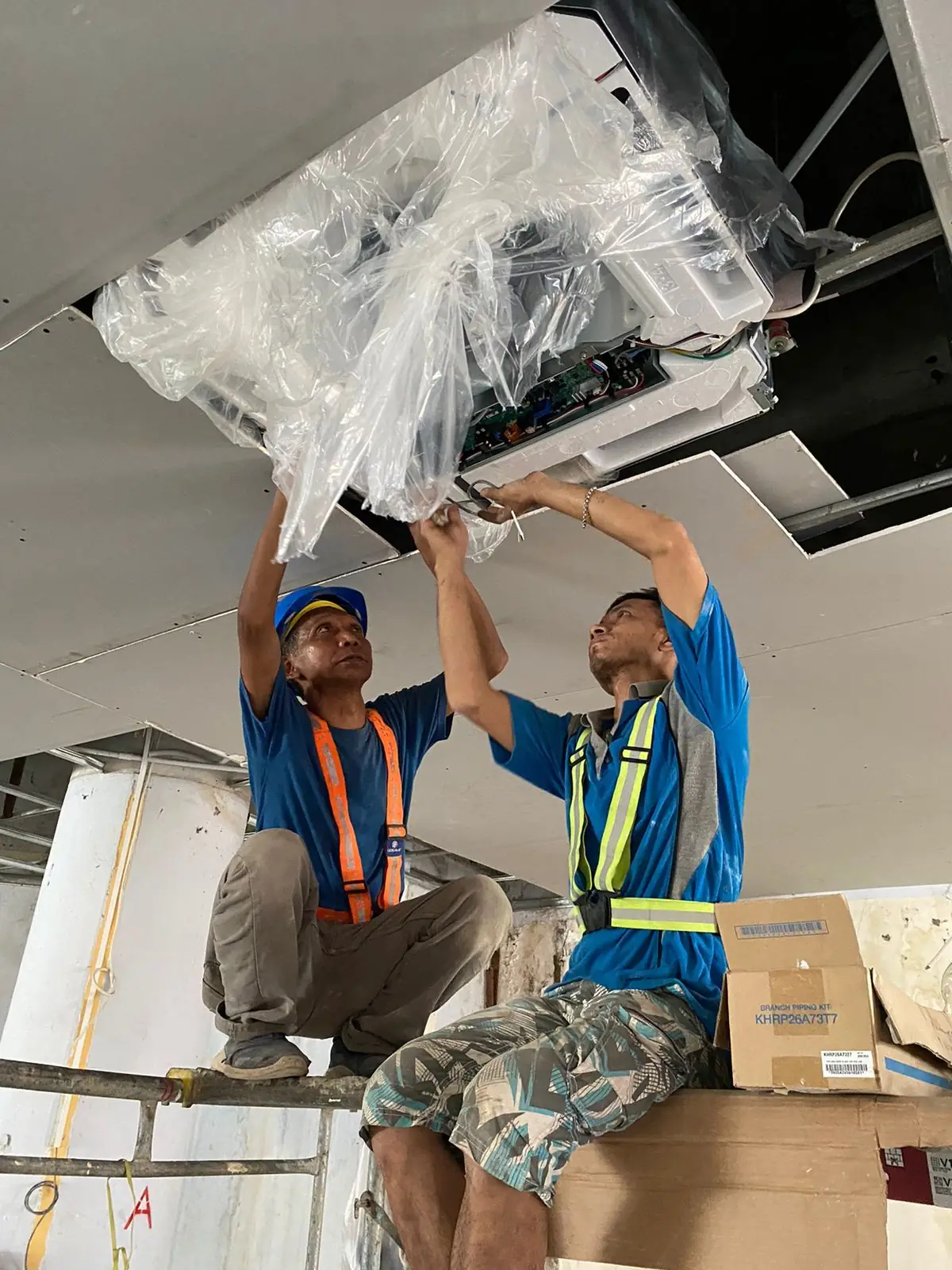
- Installation scope: standard pipe length per unit, copper pipe wall thickness, insulation, condensate drain, brackets, power and control cables, plus wall chasing and making good.
- Testing: pressure test, vacuum, measured current and supply air temperature, then a signed test report.
Installation scope is a common source of price differences between bids. The cost drivers are explained in our article on central AC installation cost.
What should be added for VRV/VRF systems?
A VRV/VRF specification needs system-level parameters, because one outdoor unit serves many indoor units through a refrigerant piping network. Key additions:
- Outdoor unit capacity and the indoor-to-outdoor connection ratio, within the manufacturer's limits.
- Maximum pipe length, equivalent length and height difference between units, per the manufacturer's manual.
- Refnet joints or branch kits from the same manufacturer as the system.
- Controls: a remote per room, plus central control where the building needs scheduling.
- Installation procedure: brazing with nitrogen flow, nitrogen pressure test, vacuum, and additional refrigerant charge calculated from the pipe length.
- Commissioning by technicians who know the system, with a report per unit.
- As-built drawings, and a BIM model where the building meets the criteria in Regulation 22/2018.
If you are still choosing between VRV and a chiller, start with our VRV vs chiller comparison. Our VRV installation scope is on the VRV/VRF systems page.
How should a KAK for AC installation or maintenance be structured?
A KAK for AC installation or maintenance follows the usual KAK structure, filled with air-conditioning content. A typical order:
- Background, purpose and objectives.
- Work location and the list of rooms served.
- Funding source and estimated cost.
- Scope: installation, testing, commissioning, operator training.
- Outputs: units installed and working, test reports, as-built drawings, operating manuals.
- Work period and maintenance period.
- Personnel: qualifications of the site lead and technicians for the scope.
- Minimum tools: vacuum pump, manifold gauge, nitrogen, brazing kit, clamp meter.
- Reporting: daily or weekly reports, photo records, final report.
For a maintenance KAK, add the service schedule, the task list per visit and a checklist form per unit.
What mistakes happen most often?
The most common mistake in an AC procurement specification is being either too vague or locked to one brand. A vague specification produces bids that cannot be compared, while a brand-locked one invites bid protests because it limits competition. These five mistakes appear most often:
| Mistake | Result | Fix |
|---|---|---|
| Capacity written only in PK | Bids cannot be compared | State BTU/h or kW from a load calculation |
| Naming a brand without grounds | Unfair competition, risk of bid protests | Write performance parameters several products can meet |
| Installation scope not itemised | Variation orders during the work | Itemise piping, insulation, drain, electrical, brackets and making good |
| No testing requirement | Units installed without proof of performance | Require pressure test, vacuum and a signed test report |
| No handover documents | Maintenance is hard in later years | Require as-built drawings, manuals and a unit list per room |
Conclusion
A good AC technical specification and KAK let you compare bids line by line and make the finished work easy to inspect. The essentials are capacity from a load calculation, measurable parameters, a complete installation scope and clear testing requirements.
SOKANTARA is an HVAC, VRV/VRF and MEP contractor with its head office in Medan, serving projects across Indonesia. We help consultants and agencies prepare load calculations, BOQs and specifications from a BIM MEP model, then deliver HVAC installation through to commissioning. If you are preparing a procurement package, contact our team.
Frequently asked questions
Can a specification name an AC brand?
In principle, no. Indonesia's procurement regulation only allows brand names in specific cases, such as components, spare parts, part of an existing system, or goods in the e-catalogue. Otherwise, write performance parameters that several products can meet.
Is it enough to state capacity in PK?
Stating capacity in PK alone is not enough, because PK is a trade label that is not consistent between manufacturers. State cooling capacity in BTU/h or kW, based on a room-by-room load calculation.
When does an AC project require BIM?
Under Minister of Public Works Regulation 22/PRT/M/2018, BIM is mandatory for non-simple state buildings above 2,000 m² and above 2 floors, including mechanical and electrical utility drawings.
What is the difference between a technical specification and a KAK?
A technical specification describes the goods, such as the AC units and materials. A KAK (terms of reference) describes the service work, such as installation, testing or maintenance. An installed AC package usually needs both.