Before a VRV system is handed over, the building owner needs proof that the pipes do not leak, the refrigerant charge is correct, and every room gets the cooling it was designed for. That proof comes from commissioning recorded stage by stage. Without those records, installation faults only show up once the building is in use.
This guide is for building owners, facility managers, MEP consultants and site supervisors who are about to accept a VRV system. It covers the commissioning sequence, common pass criteria, and the documents to ask for at handover.
The test values below are typical ranges. The binding values are always the ones in the installation manual for the installed unit model.
What is VRV commissioning and why does it matter?
VRV commissioning is a staged verification process, from the installation check to performance measurement, with every result recorded and signed. A VRV system serves many indoor units from one refrigerant pipe network. A small error, such as a tilted refnet joint, swapped control wires or a refrigerant charge a few kilograms short, can reduce the performance of the whole system.
These faults often appear months later as error codes or rooms that do not cool. Commissioning finds them while the contractor is still obliged to fix them under the contract.
What is the sequence for commissioning a VRV system?
A VRV system is commissioned in seven stages, and each stage starts only after the previous one has passed.
| Stage | What is checked | Common pass criterion | Record to request |
|---|---|---|---|
| 1. Installation check | Unit positions, pipe routes, refnet joints, insulation, supports, drains | Matches the shop drawings and the pipe length limits in the manual | Visual checklist and photos |
| 2. Pressure test | Refrigerant pipe leaks, using dry nitrogen | No pressure drop over the holding time (usually 24 hours) after temperature correction | Pressure test sheet |
| 3. Vacuum | Air and moisture inside the pipes | Reaches the target vacuum and does not rise during the hold | Vacuum sheet and holding time |
| 4. Additional refrigerant charge | Refrigerant amount for the liquid pipe length | Weighed amount equals the calculated amount | Calculation and label on the outdoor unit |
| 5. Electrical and controls | Voltage, phase sequence, insulation resistance, control wiring, unit addresses | Matches the manual, no communication errors | Electrical measurement sheet |
| 6. Test run | Outdoor unit automatic check and operation of each indoor unit | Completes without error codes | Test run result |
| 7. Performance measurement | Supply and return temperatures, airflow, drainage, noise | Matches the design for each room | Measurement sheet per room |
What is checked before testing starts?
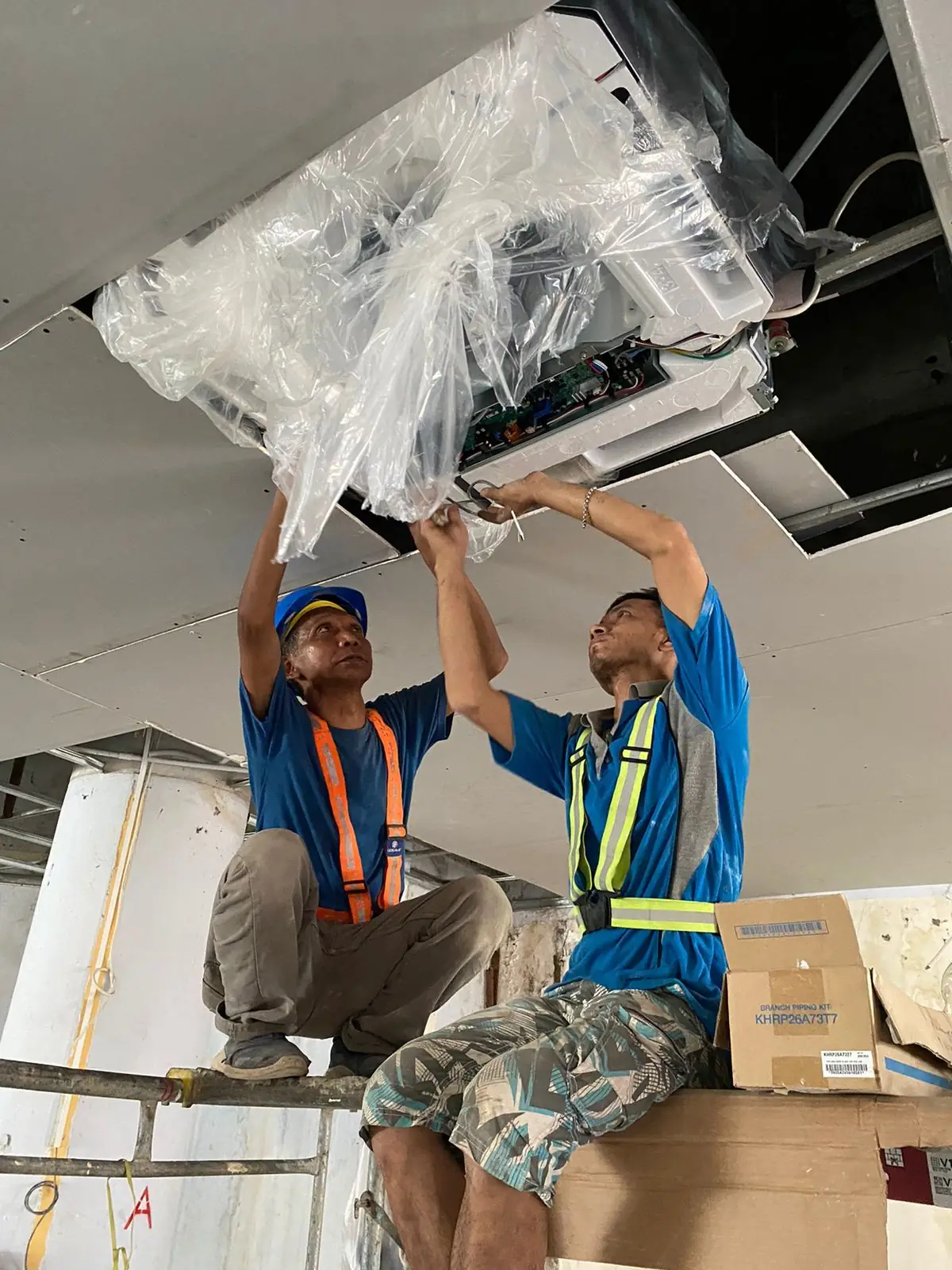
The pre-test check confirms that the physical installation matches the working drawings. The commissioning engineer compares outdoor and indoor unit positions, the pipe size on each branch, refnet position and orientation, and pipe lengths and height differences against the limits in the manual.
The check also covers sealed pipe insulation, pipe supports, drain pipe slope and the clearance around the outdoor units. On projects with a BIM model, comparing against the model speeds this up, because site changes can be marked straight away as as-built.
How are the pressure test and vacuum done?
The pressure test proves the refrigerant pipes do not leak before any refrigerant goes in. The pipes are filled with dry nitrogen to the test pressure in the manual. For many R410A systems this is about 4.0 MPa. The pressure is then held, usually for 24 hours. A change that follows the air temperature is normal; any other drop means a leak that must be found and repaired.
Vacuuming removes air and moisture from the pipes. The vacuum pump runs until the target in the manual is reached, typically about −100.7 kPa (−755 mmHg), or below 500 microns on a digital vacuum gauge. After the pump is switched off, the pressure must stay stable over the holding time, often one hour. A rising reading means moisture or a leak is still present.
How is the additional refrigerant charge determined?
The additional charge is calculated from the actual liquid pipe length for each diameter, using the kg-per-metre factors in the manufacturer's manual. A VRV outdoor unit ships with the charge for the unit itself only, so refrigerant for the site pipework is always added during commissioning.
The refrigerant is weighed on a digital scale instead of being judged from pressure readings. The total is written on the outdoor unit label and in the report, because the figure is needed again for maintenance and for leak tracing later.
What is checked on the electrical supply and control wiring?
The electrical check makes sure the units are safe to start. Supply voltage is measured and is generally required to be within ±10% of the rated voltage, the phase sequence is checked, and insulation resistance is measured with a megger, generally at least 1 MΩ. Breaker sizes and earthing are checked against the manual.
Control wiring between units is traced, must not share a route with power cables, and every indoor unit address is recorded. Many VRV manuals also require the outdoor unit to be powered for several hours before it runs, often six, so the crankcase heater can warm the compressor.
What happens during the test run?
The test run is an automatic check started from the outdoor unit after all stop valves are fully open. It checks that the wiring and piping between units match, the stop valve status, and whether the refrigerant charge is adequate. A fault shows as an error code. The common codes are listed in our article on Daikin VRV error codes.
Once the automatic test run finishes without errors, each indoor unit is operated from its remote or the central controller. The drain test is done by pouring water into the drain pan and confirming that the drain pump and drain line work.
What is measured to prove performance?
Performance measurement proves that each room gets the cooling it was designed for. A unit that runs without errors may still not cool its room enough. The engineer records supply and return air temperatures at every indoor unit, room temperatures, outdoor unit pressures and currents, and airflow for ducted units. The results are compared with the design data and the manufacturer's data.
Rooms that miss the target temperature are checked again before handover. Common causes are the static pressure setting on ducted units, dampers that have not been balanced, or a room load that differs from the original calculation.
Which documents should you receive at handover?
The handover documents are the written proof that commissioning was carried out and passed. Ask for this package before signing the handover certificate:
- A commissioning report with the pressure test, vacuum, refrigerant charge, electrical, test run and per-room measurement sheets.
- As-built drawings of the refrigerant piping, refnet positions, control wiring and unit addresses.
- Operation and maintenance manuals, plus a list of consumables such as filters.
- Proof of warranty registration or the warranty terms from the manufacturer or distributor.
- A record of the training given to the building operators.
- The punch list of open items, each with a deadline.
These documents are also the basis for the maintenance contract. The scope and schedule of routine maintenance are covered in our article on office AC maintenance terms of reference. For government procurement, put the commissioning obligation and these documents into the AC technical specification from the start.
Conclusion
Ask for written records at every stage of VRV commissioning, and sign the handover certificate once you have the complete report. Open findings go on the punch list with clear deadlines.
SOKANTARA is an HVAC, MEP and BIM contractor headquartered in Medan, serving all of Indonesia. We carry out VRV/VRF installation and commissioning for buildings, including the handover documents. Get in touch through our contact page to discuss your project.
Frequently asked questions
How long does VRV commissioning take?
It depends on the number of units and how ready the building is. The pressure test alone is usually held for 24 hours, and vacuum and testing take several more days. Large systems with many outdoor units are done one refrigerant system at a time.
Who should attend VRV commissioning?
The installing contractor, the MEP supervisor or consultant, and a representative of the owner or facility manager. On large systems the manufacturer or distributor sometimes joins the test run and the warranty registration.
Is commissioning the same as a test run?
No. The test run is one stage. Commissioning also covers the installation check, pressure test, vacuum, refrigerant charging, performance measurement and the handover documents.
Can handover go ahead with open findings?
Yes, if minor findings are recorded in a punch list with deadlines. Findings that affect safety or involve refrigerant leaks must be fixed before the system is used.